



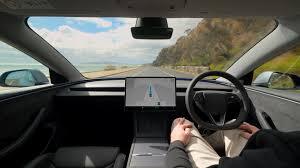
A Tesla driver has successfully completed a 4,000 kilometer road trip using Tesla Full Self-Driving without taking manual control, marking a major milestone in autonomous vehicle technology. The journey, which covered highways, city streets, and complex traffic conditions, demonstrates how far Tesla’s self-driving system has advanced in real-world usage.
This achievement has sparked global discussion across the EV, AI, and automotive industries, especially in regions like the United States, Europe, and Asia, where autonomous driving regulations are evolving rapidly.
What Happened During the 4,000 KM Tesla Trip?
According to reports shared by the driver, the entire journey relied on Tesla Full Self Driving software, with no steering, braking, or acceleration input from the human driver. The vehicle handled:
-
Highway lane changes
-
City traffic signals
-
Navigation through intersections
-
Long-distance route planning
The trip covered multiple regions and road conditions, making it one of the longest documented real world drives completed using Tesla’s autonomous system.
What Is Tesla Full Self Driving?
Tesla Full Self-Driving is an advanced driver assistance system (ADAS) developed by Tesla that uses artificial intelligence, neural networks, and camera based vision to automate driving tasks.
Despite its name, the system still legally requires driver supervision in most countries. However, its real world performance continues to improve with frequent over the air software updates.
Key capabilities include:
-
Autosteer on city streets
-
Traffic light and stop sign control
-
Automatic lane changes
-
Smart navigation
Why This 4,000 KM Trip Is Important
This long distance journey matters for several reasons:
1. Real World Validation
Most autonomous driving tests happen in controlled environments. This trip proved that Tesla Full Self Driving can function reliably across long distances and varied road conditions.
2. AI Learning at Scale
Tesla’s system improves through fleet data. Every kilometer driven strengthens the neural network and improves future performance.
3. Consumer Confidence
Demonstrations like this build trust among potential EV buyers considering autonomous features.
Regions and Road Conditions Covered
The journey reportedly passed through:
-
Urban city centers
-
Open highways
-
Suburban roads
-
Mixed traffic environments
Such diversity is crucial for testing Tesla Full Self Driving because driving behavior varies significantly across regions.
In countries like the United States, road infrastructure supports autonomous systems more easily, while European and Asian cities present tighter roads and complex layouts.
How Tesla’s AI Handled the Trip
Tesla relies on a vision only system, meaning it does not use LiDAR or radar in newer models. Instead, it depends on:
-
Camera based perception
-
AI-driven object recognition
-
Real-time decision-making
-
Neural network prediction
During the 4,000 KM journey, the system reportedly handled unexpected scenarios like sudden lane merges and changing speed limits with minimal intervention alerts.
Is Tesla Full Self Driving Truly Autonomous?
From a technical standpoint, Tesla Full Self-Driving is classified as Level 2 autonomy under SAE standards. This means:
-
The driver must remain alert
-
Hands may be required on the wheel
-
Legal responsibility stays with the human
However, trips like this blur the line between assisted and autonomous driving, pushing regulators to reassess future classifications.
Global Impact on Autonomous Driving Regulations
This milestone arrives at a critical time when governments worldwide are shaping self-driving laws.
-
United States: Several states are testing autonomous vehicle policies
-
Europe: Strict safety and liability frameworks remain
-
China: Heavy investment in AI-driven mobility
-
Middle East: Smart city initiatives integrating autonomous transport
Long distance demonstrations using Tesla Full Self Driving may influence how regulators view real world readiness.
Comparison With Other Autonomous Systems
Compared to competitors:
-
Waymo focuses on geo fenced autonomy
-
Cruise relies on limited city deployments
-
Tesla emphasizes global scalability
Unlike others, Tesla deploys updates directly to consumer vehicles, allowing Tesla Full Self Driving to improve continuously across millions of cars.
Safety Considerations and Criticism
While impressive, the system still faces criticism:
-
Occasional braking errors
-
Misinterpretation of road markings
-
Regulatory scrutiny after isolated incidents
Tesla maintains that driver supervision is essential and continues to release safety focused updates.
What This Means for Tesla Owners
For Tesla owners, this achievement signals:
-
Better long distance driving comfort
-
Reduced fatigue on road trips
-
Continuous software improvement
However, drivers must still follow local laws and safety guidelines when using Tesla Full Self Driving.
Future of Tesla Full Self Driving
Tesla aims to eventually introduce unsupervised autonomous driving, pending regulatory approval. Upcoming updates are expected to improve:
-
Urban navigation
-
Weather condition handling
-
Pedestrian and cyclist prediction
-
Cross border road behavior
If progress continues at this pace, fully autonomous road trips may soon become mainstream.
Frequently Asked Questions
Did the Tesla driver touch the steering wheel?
No manual steering, braking, or acceleration was used, though supervision remained active.
Is Tesla Full Self-Driving legal everywhere?
Legality depends on local regulations. Most regions require active driver supervision.
Can any Tesla model do this?
Only vehicles equipped with the latest hardware and Tesla Full Self Driving software can attempt similar trips.
Final Verdict
The 4,000 KM journey completed using Tesla Full Self Driving represents a significant step toward the future of autonomous mobility. While not fully autonomous in legal terms, the system’s real world performance shows how AI driven driving is rapidly evolving.
As infrastructure, regulation, and technology align, milestones like this could redefine how humans travel long distances.